In “Is There a Poem in the House?”, Georgia Shreve imagines inspiration as a living force that slips through domestic space, haunts language, and vanishes without warning. The poem moves between playful unease and existential dread, treating creativity as both visitation and loss. By the end, the room itself becomes an emotional map of absence, filled with tiny voids where poems once lived.

First published: 
2026

Published in

“Is There a Poem in the House?” is a poem about creative presence as a volatile, almost supernatural event. Shreve frames the poem as a sequence of apparitions: the poem appears in cracks, behind objects, in wallpaper, pipes, and books, never fully stable, never entirely controllable. What begins as a whimsical search gradually turns into a meditation on artistic anxiety, in which inspiration behaves less like a tool and more like weather.

The poem’s central achievement is tonal modulation. It begins with curiosity and sly humor, “like a Sunday guest,” then intensifies into bodily and architectural unease, where language is imagined as vapor, radiation, steam, and melting ink. The house is no longer merely setting. It becomes a pressure chamber for thought, memory, and fear of creative drought.

Shreve’s imagery is especially effective because it is tactile and spatial. Rather than speaking abstractly about writer’s block, she renders it physically: stains, seepage, drips, cavities, minute abysses. This gives the poem a lived immediacy. Creativity is not romanticized. It is hunted, sensed, lost, and mourned in real time.

The final turn is devastating and restrained. After all the signs of poetic life, the closing lines present a room riddled with small emptinesses, “where poems used to be.” That ending reframes the poem as an elegy for vanished language, while still preserving its mystery. The work ultimately captures a paradox many artists know well: inspiration can feel intimate, invasive, and utterly unreliable all at once.

Is There a Poem in the House?

By Georgia Shreve

Sometimes it appears in the cracks—
Between moments or between words—
And suddenly I know
It is in the room,
Hiding under a vase
Or slipping behind me
Sneaky as a ghost,
Watching me, stalking me,
Or seated beside me
Like a Sunday guest.
Sometimes it appears
Out of thinnest air
Like lint or dew,
Or rises like vapors
From recesses of the room.
Sometimes it bleeds through the walls,
Seeps through the wallpaper,
Like radiation on the loose,
Or builds up in the pipes
Like angry steam,
Or drips from the books,
Like melting ink.
But there are times
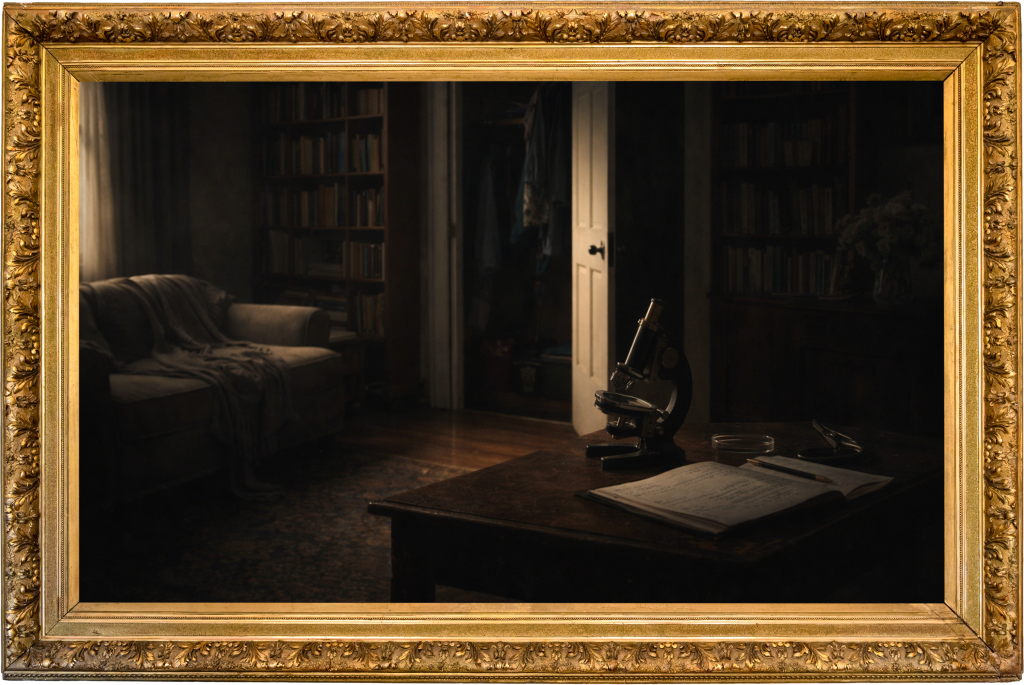
When the room is filled with cavities—
Minute abysses—
Where poems used to be.

Reading Notes

What makes this poem memorable is how fully it turns creativity into architecture. Shreve does not present writing as purely internal reflection. She stages it as a spatial event, in rooms, walls, pipes, wallpaper, and books, so that inspiration feels environmental rather than private. This strategy gives the poem unusual dramatic life: the speaker is not just thinking, but tracking a presence through physical space.

Structurally, the repeated “Sometimes” creates a pulse of recurrence and instability. Each recurrence offers a new manifestation, ghost, vapor, radiation, steam, ink, and each metaphor enlarges the poem’s emotional range. The sequence reads almost like case notes from a haunted house, except the haunting is artistic consciousness itself.

The diction balances elegance with menace. Images like “Sunday guest” and “lint or dew” suggest familiarity and domestic calm, but they are countered by “stalking,” “radiation,” and “angry steam.” That friction produces the poem’s central tension: inspiration can feel companionable and threatening in the same breath.

The closing image of “cavities” and “minute abysses” is especially strong because it avoids theatrical despair. Instead, Shreve gives us precise emptiness, small absences that accumulate until the room becomes a map of loss. This restraint makes the ending emotionally potent. The poem does not declare catastrophe. It shows erosion.

Taken as a whole, “Is There a Poem in the House?” is a sharp meditation on artistic intermittence. It honors the thrill of arrival while naming the fear of disappearance. In compact form, it captures the strange ecology of making art: visitation, vigilance, and the quiet grief of silence.

Purchase Messages Never Sent today!

Now Available: Messages Never Sent, Georgia’s debut poetry book, at select Manhattan bookstores and on Kindle.

Explore more

Poetry

by Georgia

VIEW FEATURED WORK

Explore more works by Georgia

VIEW FEATURED WORK

Inspired by Georgia’s Work?

 If her creativity moved you, let her know! Click below to send a message of appreciation directly to Georgia.